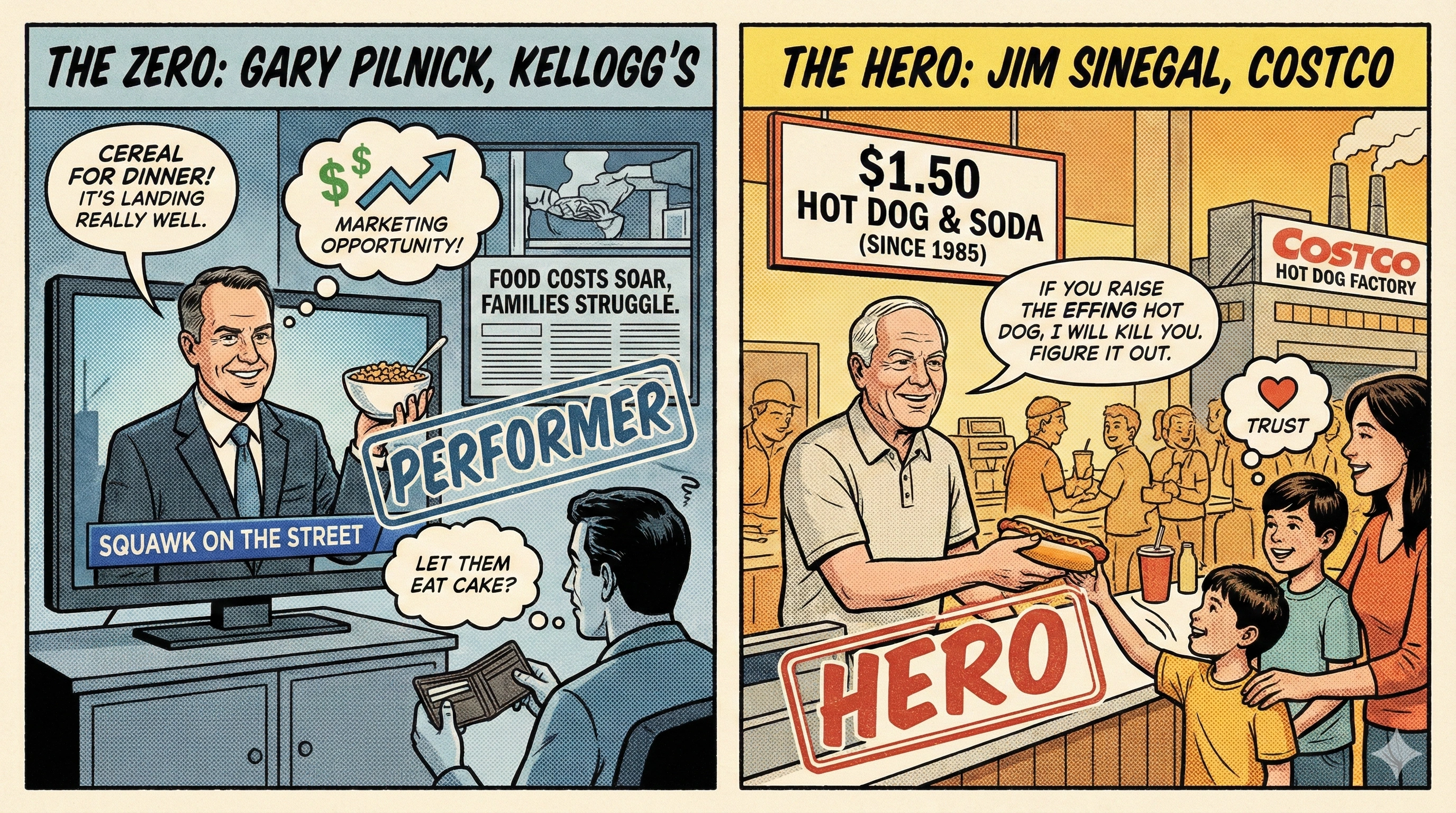
THE ZERO: Gary Pilnick, Kellogg's
The story: In February 2024, as Americans spent more of their income on food than at any point in 30 years, WK Kellogg CEO Gary Pilnick posed buying cereal for dinner to save money on groceries in an appearance on CNBC's "Squawk on the Street."
"The cereal category has always been quite affordable and it tends to be a great destination when consumers are under pressure," the cereal company's CEO said.
When asked if his suggestion might "land the wrong way," Pilnick said: "It's landing really well right now."
It was not landing well.
"Greedflation is forcing families to make choices like eating cereal for dinner to save money. Kellogg's CEO is bragging about it while they show the huge climb in corporate profits that helped create the problem in the first place."
Some consumers have called the comments tone deaf from an executive who made more than $4 million last year. They note that boxes of popular cereals now cost more than $7.
Kellogg's has been raising their prices by 17.1% in the last two years while encouraging consumers to increase purchases, exposing a discrepancy behind their messaging and consumer expectations.
One TikTok user went so far as to say: "This is Kellogg's version of 'let them eat cake'"—using a phrase often attributed to the last Queen of France, Marie-Antoinette, who was deemed blind to the poverty of her subjects.
Kellogg and its PR representatives have ignored repeated requests for comment. The silence only amplified the backlash. "This is a textbook example of what not to do," said Paul Argenti, professor of corporate communication at Dartmouth.
Why it's performer: Pilnick's mind was filled with one question: "How do we increase consumption of our product?"
Not: "Families are struggling. How can we help?"
He saw the financial pressure on American families not as a crisis to address but as a marketing opportunity to exploit. The message wasn't "we're cutting prices to help you through hard times." It was "your hardship is good for our business."
What heroic would look like: "We know families are struggling right now. We're freezing prices on our staple cereals through the end of the year, and we're partnering with food banks to make sure no family has to choose between feeding their kids and paying rent."
THE HERO: Jim Sinegal, Costco
The story: The big-box warehouse famously charges only $1.50 for a hot dog and soda combo, which hasn't increased since 1985.
Not because it's profitable. A Costco employee in 2018 told Popsugar that the company makes just $0.08 on every hot dog combo deal.
When former CEO Craig Jelinek tried to raise the price, founder Jim Sinegal shut him down hard:
"I came to (Jim Sinegal) once and I said, 'Jim, we can't sell this hot dog for a buck fifty. We are losing our rear ends.' And he said, 'If you raise the effing hot dog, I will kill you. Figure it out.'"
So they figured it out. In 2008, Costco began using its own hot dog factories, reducing supply chain costs. They built their own manufacturing plant just to keep the price stable.
When asked why the price of the hot dog was significant to him, Jim Sinegal said, "Because everybody talks about it. People look at that hot dog and say a buck fifty, this is unbelievable. We're known for that hot dog. That's something you don't mess with."
The philosophy extended beyond hot dogs. Good wages and benefits are why Costco has extremely low rates of turnover and theft by employees. And Costco's customers stay loyal because they like that low prices do not come at the workers' expense. "This is not altruistic," Sinegal said. "This is good business."
Mr. Sinegal, who has been in the retailing business for more than a half-century, said that heeding Wall Street's advice to raise some prices would bring Costco's downfall.
Despite Costco's impressive record, Mr. Sinegal's salary was just $350,000, although he also received a $200,000 bonus. That puts him at less than 10 percent of many other chief executives, though Costco ranks 29th in revenue among all American companies.
Current CEO Ron Vachris has carried on the philosophy: "We will never succumb to not being the best price and driving prices down for our members."
Why it's heroic: Sinegal's mind wasn't filled with "How do we extract maximum value from customers?" It was filled with: "What does it feel like to be a family walking into this store? What do they need from us?"
The food court feeds into the narrative of respect towards customers; if they know they are getting an amazing deal on food, they are more confident Costco is charging them fairly on other items.
That's the indirect path. By obsessing over what customers need, Costco built one of the most successful retailers in history. By obsessing over what shareholders want, other companies erode the very trust that makes long-term success possible.
THE FRAMEWORK
| Aspect | Performer (Pilnick) | Hero (Sinegal) |
|---|---|---|
| Response to struggling customers | "Marketing opportunity" | "Build a hot dog factory" |
| Mind filled with | How do we sell more? | How do they feel walking in here? |
| When costs rise | Raise prices 17% | Figure it out |
| CEO compensation | $4+ million | $350,000 |
| Customer relationship | Transactional extraction | Long-term trust |
THE LESSON
When a CEO sees families under financial pressure and thinks "great opportunity for us," they've revealed exactly what fills their mind: themselves.
When a CEO builds an entire manufacturing facility just to keep a $1.50 promise to customers, they've revealed what fills their mind: the experience of the person on the other side of the transaction.
The irony is that Sinegal's approach—the one that looks like sacrifice—built a company worth over $300 billion. The extraction approach? It builds boycotts, viral backlash, and a slow erosion of the trust that makes customers come back.
Heroes don't see customer hardship as a market to exploit. They see it as a problem to solve.