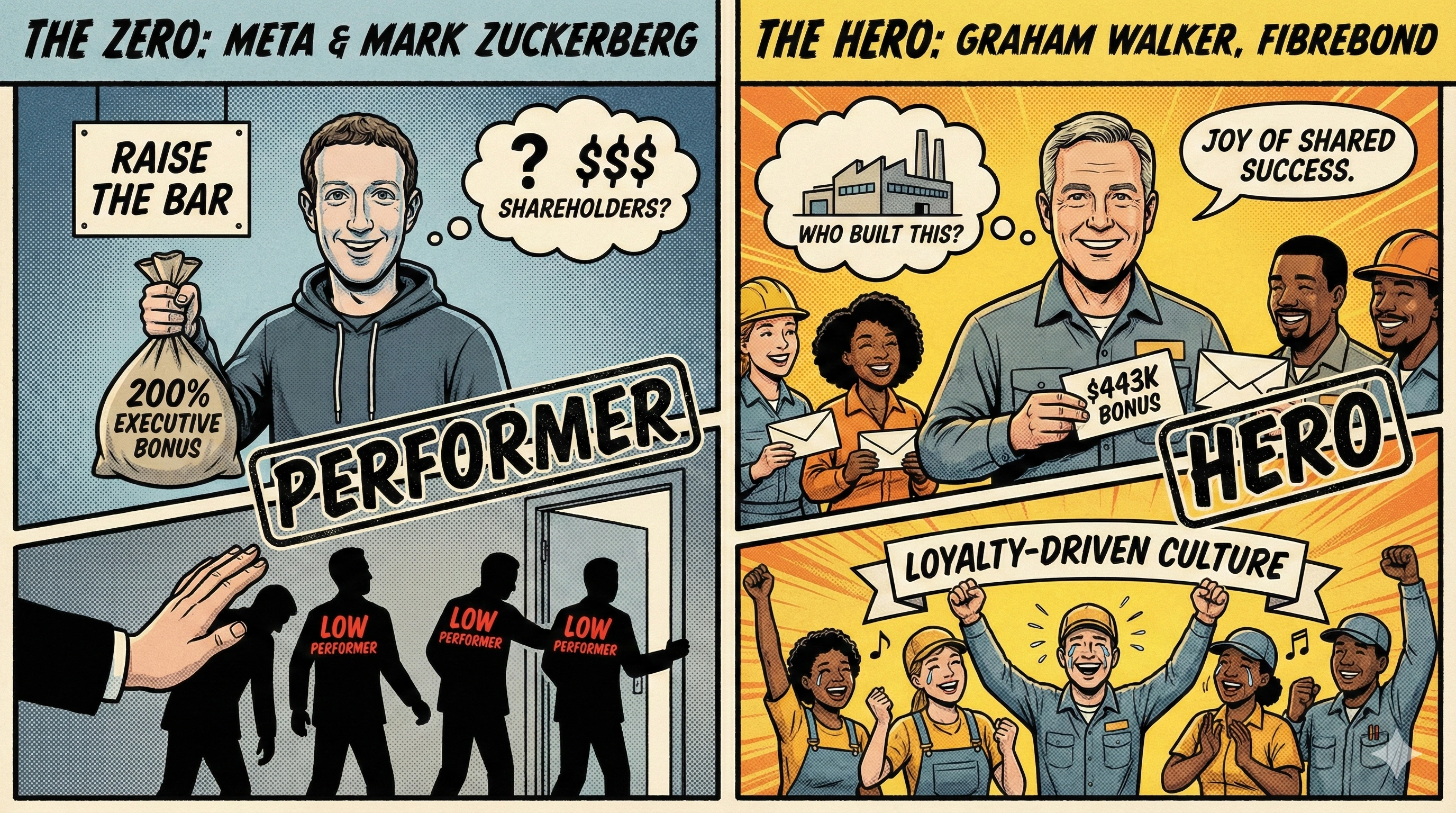
THE ZERO: Meta's "Low Performer" Purge
The story: In January 2025, Mark Zuckerberg announced Meta would "raise the bar on performance management and move out low performers faster."
3,600 employees were terminated.
One week later, the company said in a corporate filing that it had approved "an increase in the target bonus percentage" for its annual bonus plan for executives. Meta's named executive officers could earn a bonus of 200% of their base salary under the new plan, up from the 75% they earned previously.
But here's what made the cuts especially brutal: several workers took to LinkedIn to express their confusion at being laid off in the so-called "performance-based cuts."
"I frequently asked for feedback and was always told I was doing a good job," Kaila Curry, an ex-content manager at Meta, wrote in a LinkedIn post. "I was never placed on a PIP [performance improvement plan], never given corrective feedback, and never properly mentored or provided clear expectations. I simply put in the work... I am not a low performer."
"The hardest part is Meta publicly stating they're cutting low performers, so it feels like we have the scarlet letter on our backs," one employee told Business Insider. "People need to know we're not underperformers."
A Meta employee was fired while on leave caring for his terminally ill wife. This happened after he'd received a 120% performance bonus (which signals "exceeds expectations" at Meta). HR called unexpectedly during a manager's meeting and terminated him without severance. His health insurance expired that same night.
Experts noted: "It's a terrible way to be labeled and is clearly unhelpful for anyone in a job market," said Sally Maitlis, a professor of organizational behavior and leadership at Said Business School.
Why it's performer: Zuckerberg's mind was filled with one question: "How do we make this look good to shareholders?"
The answer: call it "performance management" instead of "cost-cutting." Brand the departing workers as failures. Nearly triple executive bonuses a week later. "The fact that they are backfilling means it's not that they need fewer people. It's that they felt that they had to clean house, as it were, and try to get rid of their worst performers," said Peter Cappelli. "Maybe they think the investors like that."
The workers weren't people with families, mortgages, and reputations to protect. They were "low performers"—a permanent label that follows them into every future interview.
What heroic would look like: "We're reorganizing around AI priorities, and some roles no longer fit our direction. This isn't about individual performance—many of these employees have contributed meaningfully—it's about strategic change. We'll provide extended severance and career support."
THE HERO: Graham Walker, Fibrebond
The story: When Graham Walker sold Fibrebond—the Louisiana manufacturing company his father founded—for $1.7 billion, he did something almost unheard of.
The 46-year-old CEO carved out a roughly $240 million bonus pool from the $1.7 billion sale to power-management giant Eaton, an amount that works out to an average of $443,000 per worker.
Walker insisted that 15% of the sale proceeds be reserved for employees, even though they owned no stock, making the condition nonnegotiable for any buyer.
When asked why 15%? He replied simply: "It's more than 10%."
"The requirement was non-negotiable," he said, explaining that longtime employees who helped the company survive repeated downturns deserved to benefit from its success.
The backstory matters. The Walker family continued paying employees while the company rebuilt after a factory fire in 1998, a move many workers still cite as the foundation of Fibrebond's loyalty-driven culture.
The employees survived the fire, the dot-com bust, layoffs, frozen salaries, and years of uncertainty. Walker remembered.
When envelopes detailing the surprise payouts landed, reactions on the factory floor ranged from disbelief to tears, with some workers initially assuming the news was a joke.
Lesia Key, a 29-year veteran who began working at the company in 1995 earning $5.35 an hour, broke down in tears. "Before, we were going paycheck to paycheck," she said. "I can live now."
In his letter to employees, Walker wrote: "Last week was for the team that built Fibrebond. Men and women who know the pain required to build this business got to experience the joy of shared success. The deep respect displayed among employees was profound and sacred."
Why it's heroic: Walker could have pocketed the full $1.7 billion. He owned the company. The employees owned nothing. Legally, ethically, by every standard measure—he owed them nothing beyond their paychecks.
But his mind wasn't filled with "What do I get from this?" It was filled with: "Who built this thing I'm selling? Who stayed through the fire? Who trusted us when we couldn't pay them what they deserved?"
He answered that question with $240 million.
THE FRAMEWORK
| Aspect | Performer (Zuckerberg) | Hero (Walker) |
|---|---|---|
| Mind filled with | Shareholder optics | Who built this? |
| Language about workers | "Low performers" | "Men and women who know the pain required to build this business" |
| What departing workers received | A reputation-damaging label | Life-changing wealth |
| Executive compensation | Nearly tripled bonus same week | Personal sacrifice from sale proceeds |
| Long-term effect | Scarlet letter, broken trust | "The joy of shared success" |
THE LESSON
Eighty-two percent of companies still plan to give executives bonuses this year. Meanwhile, nearly a third of companies plan to lay off workers before the end of the year.
This is the performer's playbook: extract value for those at the top while minimizing obligations to everyone else.
Graham Walker showed a different way. Not because it was required. Not because anyone was watching. Because his mind was filled with the people who'd given decades of their lives to something he was about to profit from enormously.
Heroes don't ask "What can I legally get away with?"
They ask "What do these people deserve from me?"