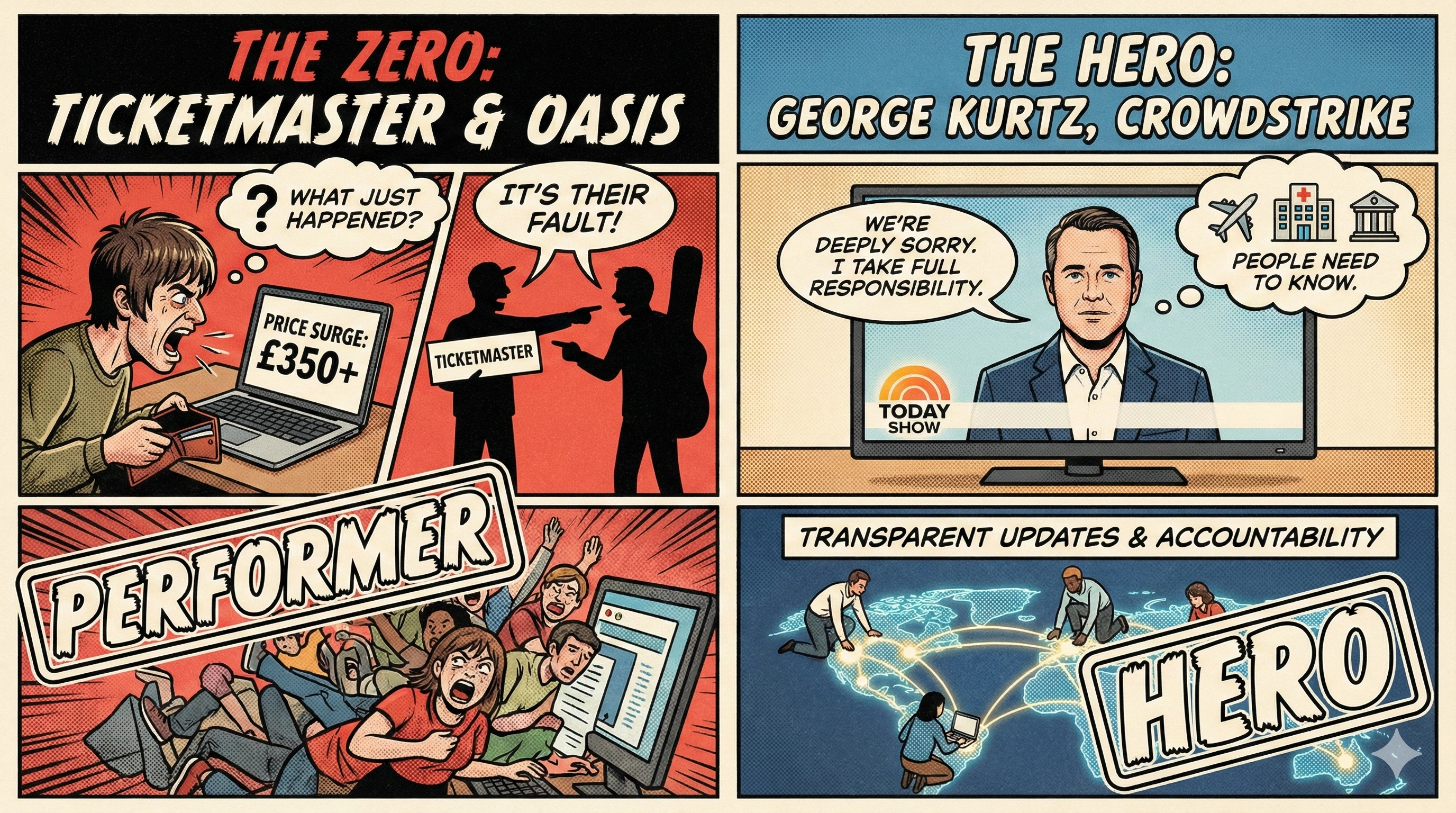
THE ZERO: Ticketmaster (The Oasis Debacle)
The story: When Oasis announced their reunion tour in August 2024, millions of fans queued for hours on Ticketmaster's platform. Standing tickets for the tour had initially been advertised for around £150. But by the time fans reached the front of the line, the face value of some tickets rose from £135 (about $200) to over £350 (about $469).
The reason? Ticketmaster's "dynamic pricing"—prices that surge based on demand while you're waiting in line to buy.
Then came the blame game.
Ticketmaster refutes the claim that it set the ticket pricing policy, saying that artists and promoters were responsible.
Oasis said in a statement that lead band members Liam and Noel Gallagher didn't know that dynamic pricing would be used. They blamed their management and Ticketmaster.
Neither Oasis nor Ticketmaster released a holding statement. Instead, they moved straight to the blame game.
The Cure's Robert Smith saw through it: "It is a greedy scam—and all artists have the choice to not participate. If no artists participated, it would cease to exist."
Why it's performer: Every party involved had one question on their mind: "How do I avoid looking like the bad guy?"
Not one person asked: "What just happened to these fans who waited for hours, and how do we make it right?"
The customer—the fan who took time off work, waited in a digital queue for eight hours, and watched the price double before their eyes—was invisible. Everyone was too busy pointing fingers to see the actual human being on the other end.
What heroic would look like: "We understand that thousands of fans had an experience that didn't match their expectations. Regardless of whose policy this was, we're issuing partial refunds to everyone who paid surge prices, and we're committed to transparent pricing going forward."
THE HERO: George Kurtz, CrowdStrike
The story: On July 19, 2024, a single software update from CrowdStrike crashed computers worldwide. Airlines grounded. Hospitals halted surgeries. Banks went dark. 911 call centers failed. It affected less than 1% of Windows devices—but that 1% included systems the world depends on.
Hours after CrowdStrike's software update crashed huge swaths of the global economy Friday, Kurtz was on "Today," apologizing for the mistake as its cascading effects were still unraveling.
His words: "I want to start by saying we're deeply sorry for the impact that we've caused to customers, to travelers, to anyone affected by this, including our company."
No hedging. No blame-shifting. No "we're investigating."
"While it wasn't malicious, it was a serious mistake, one for which Kurtz took full responsibility, apologized, and committed to resolving collaboratively," said Jen Easterly, director of the Cybersecurity and Infrastructure Security Agency.
Why it's heroic: Cybersecurity executives aren't in the habit of saying sorry or admitting to mistakes. The industry norm is deflection, legal hedging, and waiting to see how things play out.
Kurtz broke the pattern. He immediately stepped forward without a delay, an excuse, or any PR spin. He took complete accountability, explained what caused the outage, and set the stage for a continual stream of communications.
His mind wasn't filled with "How do I protect CrowdStrike's stock price?" It was filled with: "Travelers are stranded. Hospitals are down. People need to know what happened and that we're fixing it."
"Companies that acknowledge and take responsibility early, publicly and proactively, position themselves as the authority and foremost expert on the issue facing their own company."
The result: Despite distractions due to the outage and response, CrowdStrike has remained focused on serving its customers and partners. Kurtz was named Cybersecurity Person of the Year for 2024.
THE FRAMEWORK
| Aspect | Performer (Ticketmaster) | Hero (Kurtz) |
|---|---|---|
| First response | Silence, then blame others | "We're deeply sorry" |
| Mind filled with | Who's at fault? | Who's affected? |
| Communication | Finger-pointing, legal hedging | Transparent, continuous updates |
| Customer visibility | Invisible | Central |
| Outcome | Government investigation, damaged trust | Industry recognition, maintained partnerships |
THE LESSON
When something goes wrong, performers ask: "Whose fault is this?"
Heroes ask: "Who's hurting, and what do they need from me right now?"
Kurtz didn't cause the outage deliberately. Ticketmaster didn't invent dynamic pricing to specifically hurt Oasis fans. But when the crisis hit, one leader saw suffering people and moved toward them. The other saw a PR problem and tried to deflect it elsewhere.
The irony: taking responsibility is often the fastest way to move past a crisis. Deflecting blame keeps you stuck in it—with regulators, lawsuits, and broken trust extending the damage for months or years.
The hero doesn't ask "Who can I blame?" The hero asks "What can I own?"