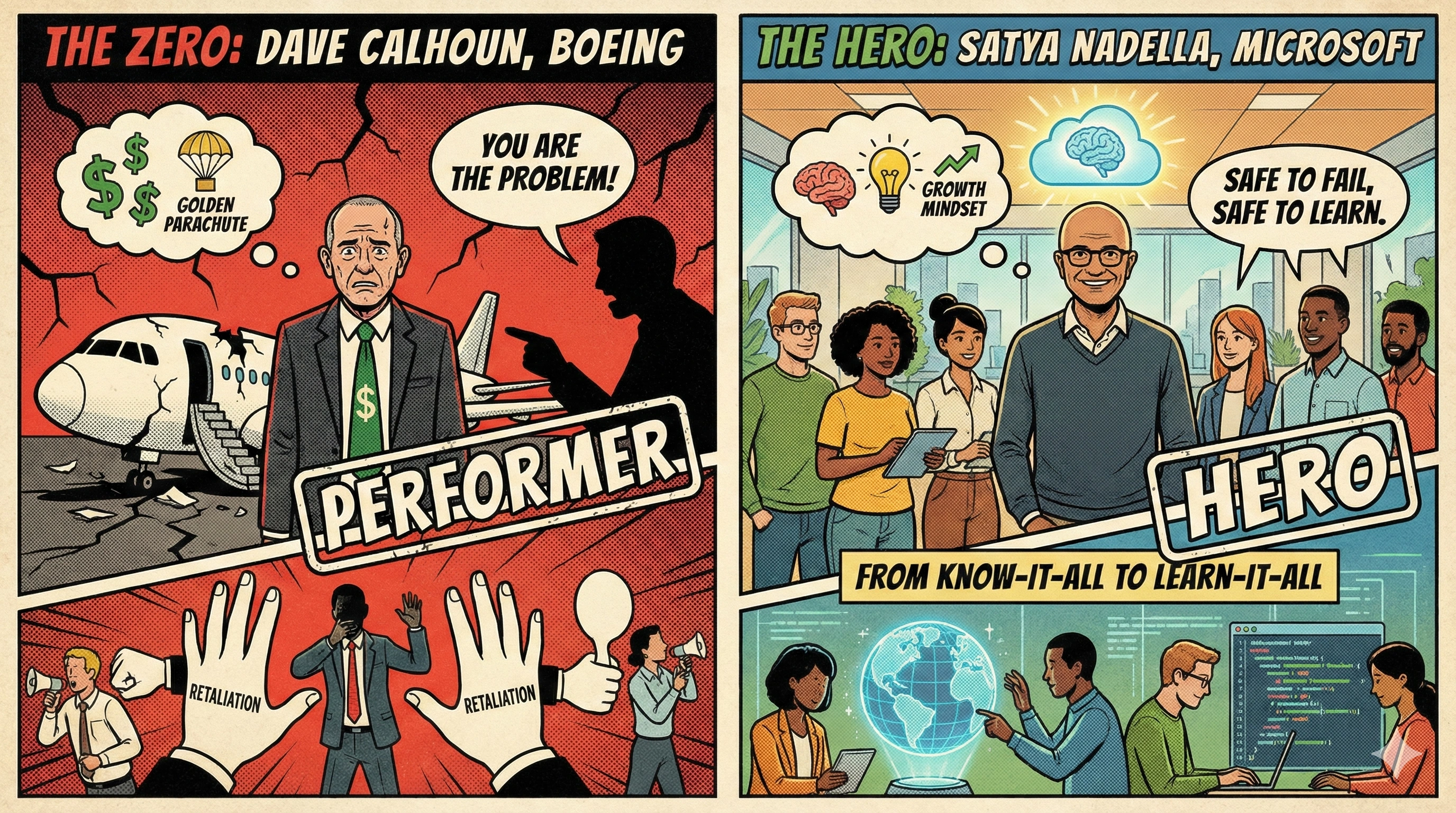
THE ZERO: Dave Calhoun, Boeing
The story: When a door plug blew off a Boeing 737 Max 9 mid-flight in January 2024, it was supposed to be the wake-up call. Instead, it became a master class in blame deflection.
"This is a culture that continues to prioritize profits, push limits, and disregard its workers," U.S. Senator Richard Blumenthal said. "A culture where those who speak up are silenced and sidelined while blame is pushed down to the factory floor."
The whistleblowers told a different story than management. Boeing manager and whistleblower John Barnett received 21 phone calls from his supervisor in a single day, and 19 on another day, after raising concerns about missing parts. When Barnett confronted the supervisor about the calls, the supervisor told him he would "push him until he broke."
Barnett was found dead in March 2024 from an apparent suicide while testifying against the company.
When Senator Josh Hawley asked Calhoun about the culture problem, he didn't mince words: "You are cutting corners. The problem is not employees, it's you. You are the problem."
Calhoun admitted that the company has retaliated against whistleblowers who raised safety concerns. But he denied that the safety issue is systemic, dismissing criticism that Boeing harbors a "broken" work culture.
Why it's performer: When 346 people die in two crashes, when a door literally blows off a plane, when whistleblowers die under "immense pressure"—a hero asks: "What have I built that allowed this?" A performer asks: "How do I protect myself from blame?"
Calhoun admitted he hasn't spoken to a single one of the company's whistleblowers, or even their families. His mind was filled with shareholders, stock price, and his $45 million golden parachute. Not the 346 dead. Not the workers trying to sound the alarm.
What heroic would look like: "Every whistleblower who raised concerns in the past five years—I want to meet with each of them personally. I want to understand what they saw that we missed. Their courage may have saved lives, and we failed them."
THE HERO: Satya Nadella, Microsoft
The story: In 2014, Nadella inherited a Microsoft that was, by most accounts, toxic. When Satya Nadella took over as CEO of Microsoft in 2014, he inherited a firm fading toward irrelevance, plagued by internal fights and inertia.
The old Microsoft was famous for "stack ranking"—employees rated against each other, forced into competition, punished for collaboration. Fear ruled. Speaking up meant risking your career.
Nadella's response? He didn't blame the employees for the toxic culture. He owned it as a leadership failure and rebuilt from the ground up.
At the heart of Microsoft's issues was its toxic, competitive culture. Nadella knew that innovation couldn't thrive in an environment full of internal silos and fear of failure.
Nadella introduced a "growth mindset" philosophy. Employees were empowered to learn, adapt, and innovate—without fear of failure.
The shift: from "know-it-all" to "learn-it-all."
"There's this feeling of empathy among teams now to try to make each other successful, instead of so much internal competition," said one employee. "He fosters this culture of learning and of respectfully questioning each other, to try to understand the other perspectives."
Why it's heroic: Nadella's mind wasn't filled with "How do I protect my position?" It was filled with "What do my people need to thrive?"
He made it psychologically safe to fail. Safe to question. Safe to learn. This shift reduced the fear of failure, giving teams the freedom to experiment and collaborate more effectively.
The result: Microsoft's market value soared from $300 billion in 2014 to over $2.5 trillion by 2023. The "fading toward irrelevance" company became the most valuable in the world.
THE FRAMEWORK
| Aspect | Performer (Calhoun) | Hero (Nadella) |
|---|---|---|
| When culture fails | Blame the factory floor | Own it as leadership failure |
| Workers who speak up | Retaliated against | Celebrated as learners |
| Mind filled with | Stock price, self-protection | "What do people need to thrive?" |
| Response to problems | Deny they're systemic | Rebuild the system |
| Result | Whistleblowers dead, planes grounded | $300B to $2.5T, innovation culture |
THE LESSON
Both inherited troubled cultures. One pushed blame downward. One absorbed responsibility upward.
The performer's question: "Who can I blame for this?"
The hero's question: "What environment did I create that allowed this?"
When employees are afraid to speak up, planes fall out of the sky. When employees feel safe to learn and question, trillion-dollar transformations happen.
The hero doesn't punish the messenger. The hero thanks them—and fixes what they found.