The Company That's Actually On Your Side
The difference is simple, yet most of us never notice it.
Every company is either a Forest or a Farm.
A Forest is an ecosystem where growth is reinvested to make the system stronger.
A Farm is a place where growth is harvested to be sold elsewhere.
You might love your job, but if you are working on a Farm, you are just waiting for the harvest season. Is your company on your side, or are you just a crop?
I switched banks three years ago over $12.
Not because I couldn't afford the fee. Because of what the fee revealed.
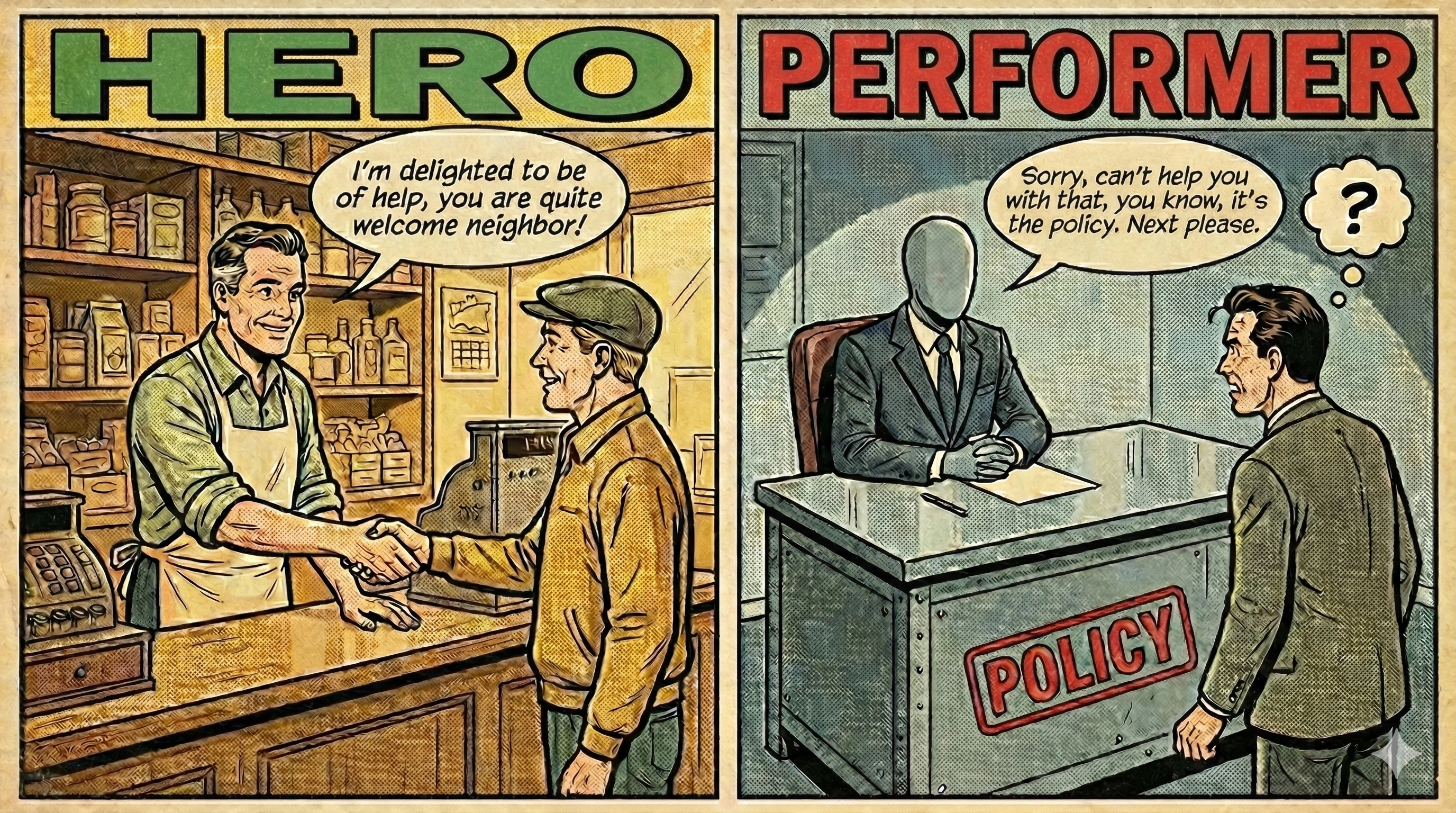
I'd been hit with an overdraft charge—my fault, miscounted a transfer. I called to ask about it. The representative was polite, professional, and utterly unhelpful. She explained the policy. She sympathized with my frustration. She offered me nothing.
Then she tried to upsell me overdraft protection.
That's when I understood: I wasn't a customer. I was a revenue source. The friction wasn't a bug—it was the product.
Six months later, different bank. Similar situation. The representative said, "Let me just remove that for you. Happens to everyone." No upsell. No policy lecture. No hoops.
Same situation. Completely different physics.
The Two Types of Companies
A Hero Company's mind is filled with thoughts of you.
A Performer Company's mind is filled with thoughts of themselves.
If a company is worried about how they look to investors, or calculating how their policies will affect quarterly numbers—their mind is filled with them. They are a performer.
If, on the other hand, a company's mind is filled with the people they serve—watching them, listening to them, figuring out how to actually help them—then you have a hero.
Why It's Confusing
Here is the tricky part: Trying to "look good" often leads to good things being done. "We have to look customer-focused" will sometimes lead to customer-focused behavior. It is a marvelous thing about organizations—they can do things for the wrong reasons and still sometimes get positive results.
It takes intelligence to hold two opposites in your mind: Appearance is everything, and appearance is nothing.
The "Performance" Trap
W. Edwards Deming, the father of the quality movement, asked a terrifying question: "What happens when management sees their responsibility as an act?"
You get actors. You get a business that is fiction.
The Deming question for customers: Do you leave feeling served, or do you leave feeling like you participated in someone's performance review?
The Silent Hero vs. The Visible Leader
A hero company may solve your problem quietly, without fanfare, because they were trying to help—not to be seen helping. A performer company will make sure you know how much they're doing for you. Press releases. Customer appreciation campaigns. Visible leadership.
Heroes don't perform service where it isn't needed because they are trying to help people—not look like helpers.
The Diagnostic
How do you tell them apart? Not by their marketing. Not by their stated values. By what happens when something goes wrong.
| Hero Company | Performer Company |
|---|---|
| Fixes problems before you escalate | Fixes problems only after public pressure |
| Policies designed for your ease | Policies that look friendly while protecting them |
| Communication when useful | Communication when they want something |
| Can admit mistakes directly | Blames circumstances, denies, or gaslights |
| You leave feeling respected | You leave feeling used |
From Predation to Service
This performative instinct plays into base corporate instincts. It turns companies into predators. The mindset becomes: "We have to look good, and it's okay if we end up doing it at your expense."
We have succeeded in making a world where companies no longer need to be predatory, yet the instinct remains. They can either continue to predate on their customers—like the cable companies of old, selling friction as a feature—or they can start actually taking care of people.
The System Makes the Performer
Companies are wired to adopt the moral system of the industry they are in. They take 75% of their values from what they see themselves as a part of. So, if you are part of a performative industry, you are going to become a performative company. If you are part of a hero culture—companies actually trying to help each other and their customers—you are going to become a hero.
If you are a hero company in a performative industry, you might get run out. You will make the performers feel bad at a deep level because you aren't playing the game.
Which One Is It?
8 questions. Rate any company. One uncomfortable truth at the end.
Hero or Performer?Fair warning: the last question is the real test.
The Aggregation
Here's what makes this different from a Yelp review.
Every response contributes to a pattern. Not "3.5 stars"—but "74% Performer." Not vague sentiment—but a specific diagnostic of whether this company's friction serves you or serves them.
Performers thrive in silence. They count on your inconvenience being too small to mention, your frustration too diffuse to articulate.
This gives it a name. And names create accountability.
The Mirror
Here's the part business owners don't want to hear.
Your customers are taking this quiz about you right now. Maybe not this specific quiz—but they're running the diagnostic in their heads every time they interact with your company.
The question isn't whether you have friction in your customer experience. Every company does. The question is whether that friction serves them or serves you.
Heroes want to know. They send surveys not for testimonials—but because they actually want to find the places where their friction has become extraction.
Performers will hate that this quiz exists.
That's the filter.
The friction either serves your need or their image. There's no in-between.
Which one are they?
Isn't the Acting Exhausting?
A short book about the exhaustion of performing authenticity instead of living it. Pay what you want. Including nothing.
Get the Book — Name Your Price